Rules
What PIPEDA and Quebec Law 25 require of Canadian analytics courses
A United States guide to PIPEDA and Quebec Law 25 courses for marketing analytics, linking privacy rules to attribution, metrics and measurement workflows.
What to take away
- PIPEDA marketing analytics courses should teach consent, retention limits, breach reporting and the Quebec Law 25 duties that apply when you analyze customer data in Canada.
- PIPEDA sets the federal baseline across Canada; Quebec Law 25 goes further with privacy impact assessments, default privacy settings and stricter consent rules.
- The Office of the Privacy Commissioner of Canada enforces PIPEDA and publishes decisions that show what goes wrong when analytics data is collected or kept without valid consent.
- A useful course maps each rule to a practical taskconsent design, retention schedules, breach playbooks and vendor contracts.
- Check for Canadian content, French-language resources for Quebec work, and a curriculum that names the regulator and the law rather than generic privacy theory.
You measure campaigns across the United States, so lawful data is your raw material. When Canadian consent is missing, retention limits expire, or breach duties trigger, your conversion paths, identifiers and lookback windows change. This guide reviews PIPEDA and Quebec Law 25 training through an attribution and metric analysis lens.
Read the rules as inputs to your attribution model, not as a separate legal topic. They decide which events you can join and which channels you can credit.
Attribution and measurement depend on data you are allowed to collect, join and keep. Consent choices, retention limits and breach duties decide which identifiers survive, how long click and conversion logs stay usable, and whether a vendor can pass data downstream.
A Canadian privacy module is not the whole measurement curriculum. It is the guardrail around it. If a course can connect those rules to attribution windows, conversion tracking, data clean rooms or marketing mix inputs, it serves a measurement practitioner better than one that only lists legal duties.
Canadian privacy rules decide what data your attribution models can use. They shape which identifiers survive, how long click and conversion logs stay joined, and whether a vendor can pass events downstream. For a United States team running campaigns into Canada, that is a measurement problem, not just a legal one.
A strong course connects PIPEDA and Quebec Law 25 to attribution windows, conversion tracking, clean rooms and marketing mix inputs. If the training stops at legal duties, you still cannot tell which channels you may credit or how to document the data behind your metrics.
What PIPEDA requires of marketers who collect and analyze data
PIPEDA applies to private-sector organizations that collect, use or disclose personal information in the course of commercial activity in Canada. For marketers, that covers email lists, website analytics, CRM records, loyalty data and ad audience files.
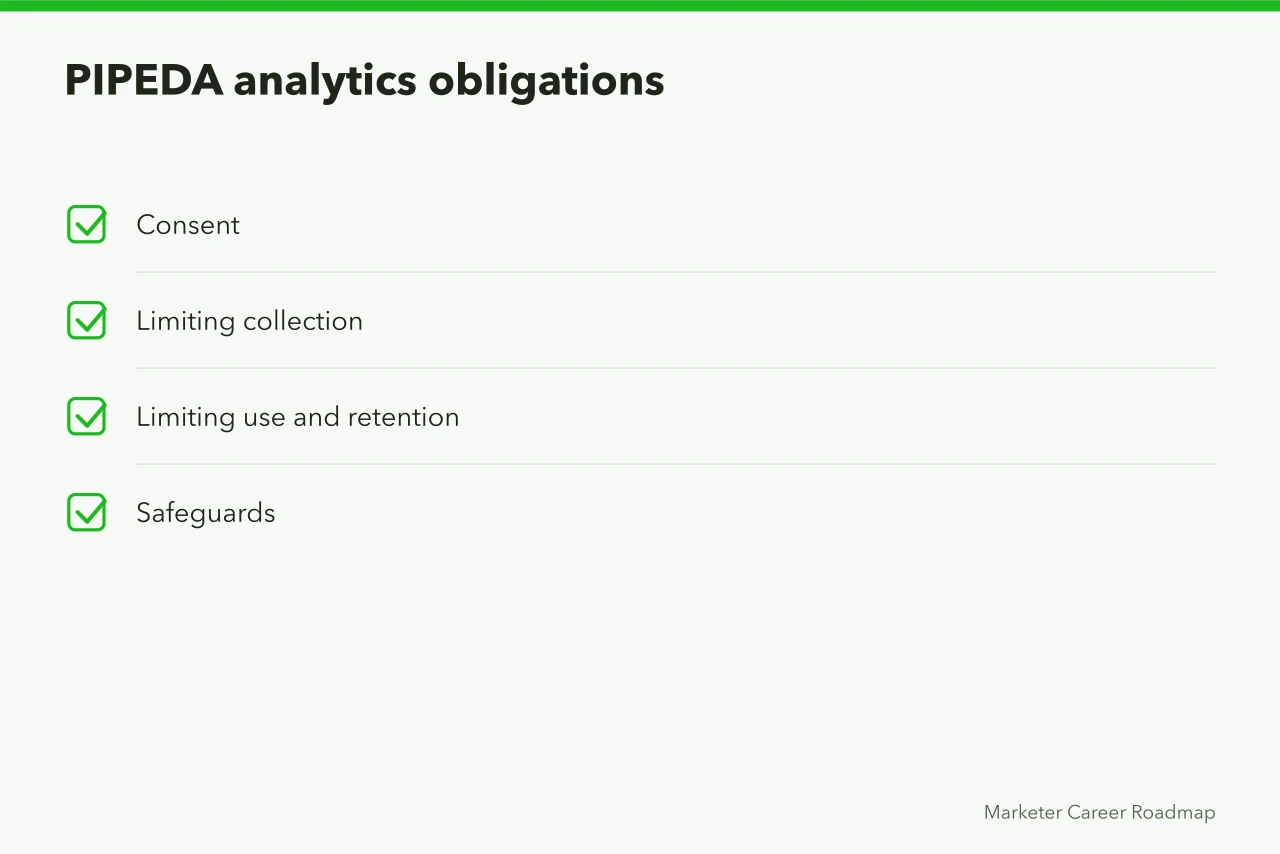
The law sets ten fair information principles, and four carry most of the weight in analytics work: consent, limiting collection, limiting use and retention, and safeguards.
The Office of the Privacy Commissioner of Canada is the regulator. Its PIPEDA overview from the OPC describes the law as the federal standard applying across Canada where no substantially similar provincial law exists. That sentence matters when you choose training for a measurement team, because a Quebec-only curriculum is not the whole picture.
The obligations themselves sit in the federal privacy statute, which requires meaningful consent and safeguards proportionate to the sensitivity of the data. Guidance from the regulator shows how those rules land on real marketing tools.
Privacy law in Canada and Quebec is not one rulebook
Privacy law in Canada and Quebec does not come from a single source. PIPEDA covers private-sector organizations in most provinces, while Quebec, British Columbia and Alberta operate their own substantially similar private-sector laws. Ontario has health-specific legislation, and the northern territories rely on the federal act.
A marketer running campaigns in Montreal, Toronto and Vancouver may be handling data under three or four regimes at once.
That is why course buyers should look for a curriculum that names each regime and explains which one bites in which situation. Generic privacy training built around European rules will not tell you which Canadian law applies to a Quebec customer list.
What counts as personal information in analytics
Under PIPEDA, personal information means information about an identifiable individual. Cookies, device identifiers, IP addresses, hashed email addresses and customer IDs all qualify. Aggregated data can still be personal information if re-identification is realistic.
Marketing training often treats anonymous as a technical setting rather than a legal question. Courses should teach the distinction, because the answer changes what you may store, how long you may keep it, and what a customer can ask you to delete.
Consent and access requests in practice
Consent must be meaningful, which means the person understands what they are agreeing to and why. For analytics, that usually means a layered privacy notice, a clear purpose statement, and an opt-out that works without a support ticket.
Access rights are the other half. Individuals can ask what you hold about them, and organizations must respond within the statutory timeline. A marketer who cannot retrieve one customer's data across the CRM, the ad platform and the analytics warehouse has a compliance problem, not a reporting problem.
Where PIPEDA stops short
PIPEDA does not set a single fixed retention period, and it does not impose European-style administrative fines scaled to global revenue. It also stops short of Quebec's impact assessments and de-indexing rights. It requires process and records, but the rules are principles rather than checklists.
Courses should teach documentation habits rather than memorized rules, because the paperwork is what gets reviewed.
If you are comparing programs, start with a list of marketing analytics careers that include a Canadian privacy module.
Quebec Law 25 and how it goes further than PIPEDA
Quebec's Law 25 modernized the province's private-sector privacy regime. It applies to enterprises operating in Quebec, including out-of-province firms that handle data of people in the province. For marketers running campaigns into Montreal, Quebec City, Gatineau or Sherbrooke, the stricter rule usually wins.
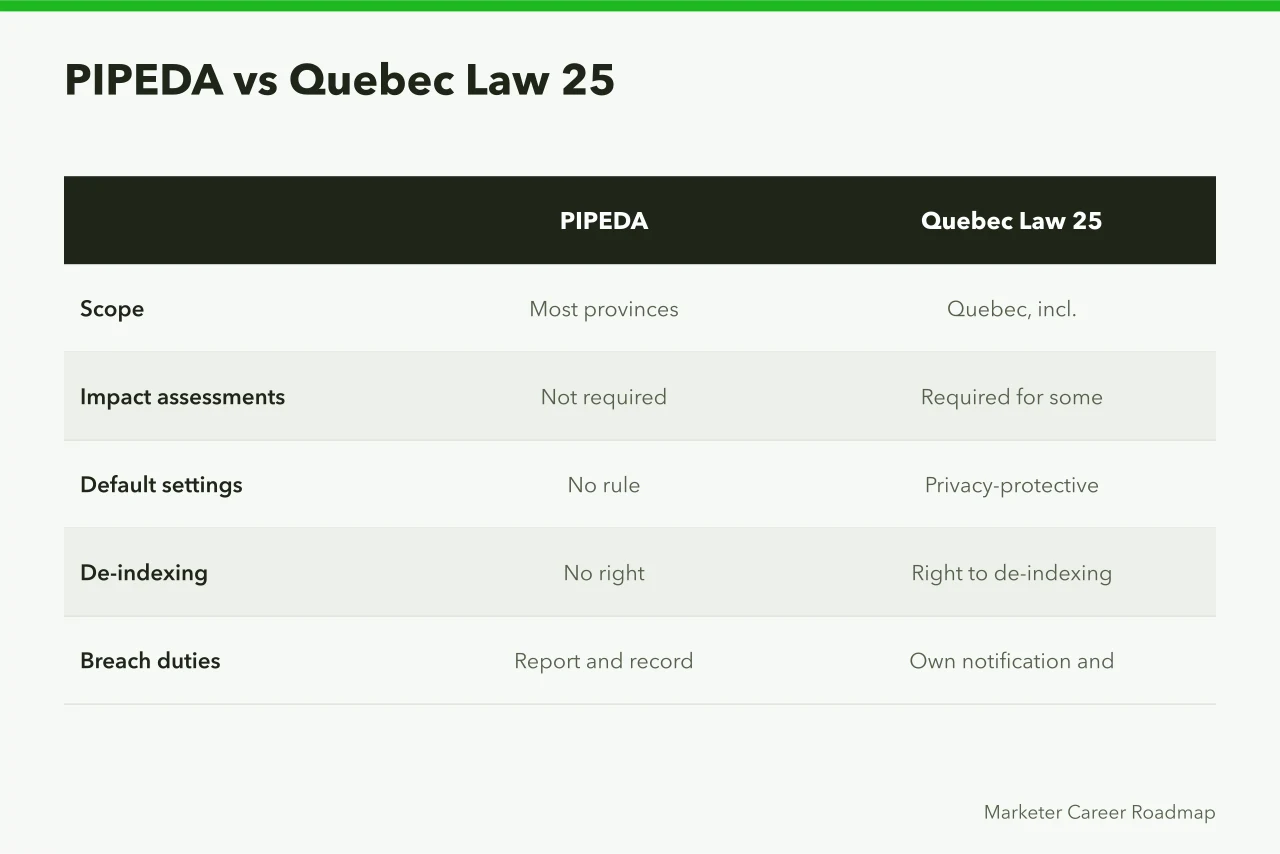
The Office of the Privacy Commissioner of Canada maintains a Summary of privacy laws in Canada that compares PIPEDA with provincial laws, including Quebec Law 25. It is not a substitute for reading the law, but it shows the shape of the Canadian patchwork and where the gaps sit.
Three duties Law 25 adds for marketing teams
First, privacy impact assessments are required for certain projects, including transfers of personal information outside Quebec. Second, consent must be clear, free and informed, and products must default to privacy-protective settings. Third, individuals can ask for de-indexing of their data and for a product to be reconfigured to stop identifying them.
Law 25 also sets breach notification and record-keeping duties, with penalties that scale by the nature of the failure. A marketing team that treats Quebec as just another province will miss these obligations entirely.
What it means for cross-border data transfers
Many Canadian marketing teams run analytics on servers outside Quebec, often in the United States. Law 25 expects an assessment before such a transfer in many cases, and it expects that assessment to be documented rather than discussed.
Course content should reflect this. The Quebec angle means French-language materials, examples from Quebec employers, and a module on transfers and vendor terms. A program that only cites American state privacy laws will not prepare you for a Quebec client or employer.
Quebec also has its own regulator, the Commission d'acces a l'information du Quebec. Courses should name it, because enforcement and guidance in Quebec come from that body as much as from the federal commissioner.
Law 25 guidance keeps changing as later provisions take effect. This article is current to 2026. Verify the text at the source before you rely on any summary, including this one: the Commission's own site at cai.gouv.qc.ca, and the federal OPC summary linked above.
If you are weighing a broader credential, a CMA Chartered Marketer review can help you judge whether privacy content is included or sold separately.
Consent, retention and breach reporting in analytics work
Consent sits at the centre of both regimes, but it is not a checkbox. Law 25 adds its own conditions on top of PIPEDA's. For analytics, a workable consent flow states the purpose, names the third parties involved, and offers an opt-out that takes effect.
Cookie banners alone rarely satisfy that standard. A banner that loads tracking before a choice is made, or that makes refusal harder than acceptance, is the kind of design that attracts complaints.
Retention schedules by purpose
Data collected for a campaign should not sit in a warehouse indefinitely. Set retention periods by purpose, document them, and delete or anonymize when the period ends. A schedule that exists only in someone's head fails on the day that person leaves the team.
Breach reporting and records
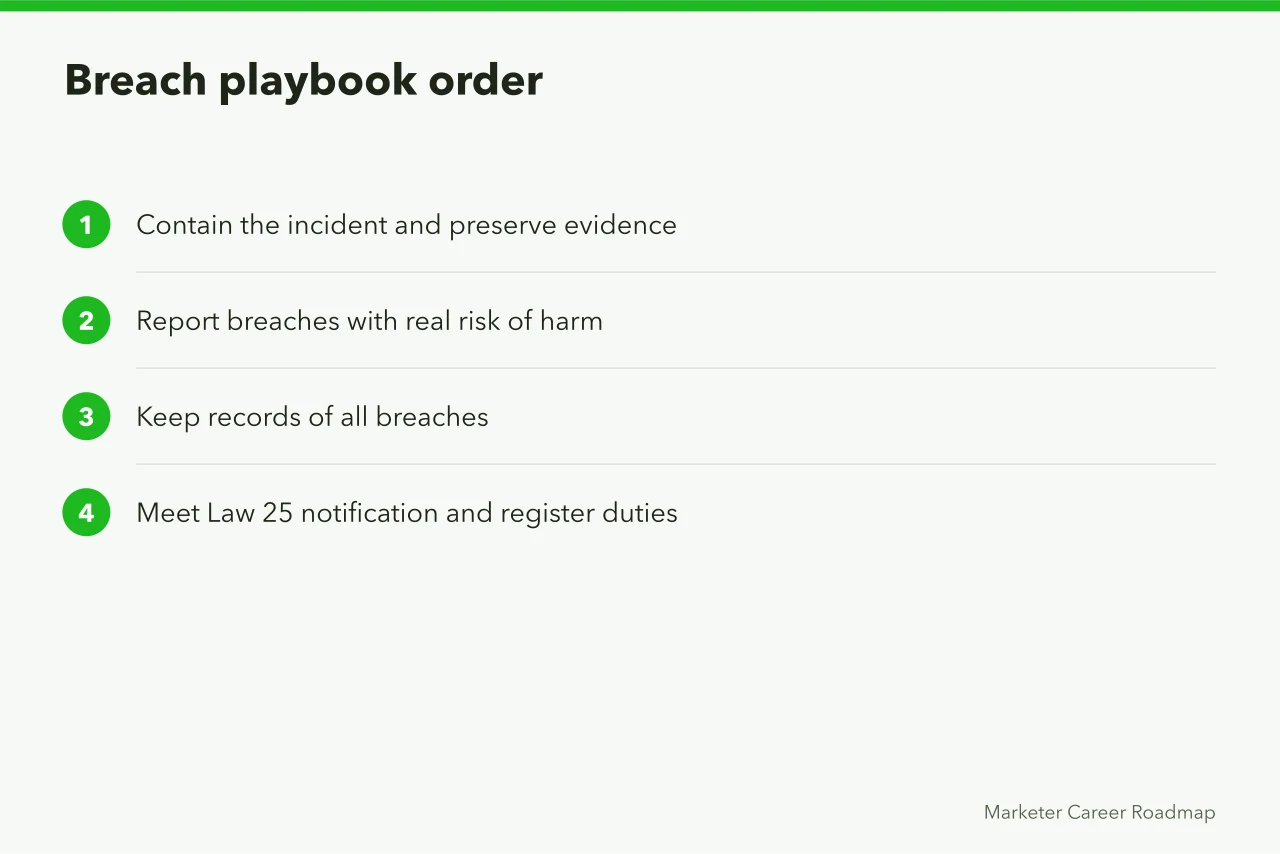
PIPEDA requires organizations to report any breach of security safeguards involving personal information that creates a real risk of significant harm. They must also keep records of all breaches, including those that are not reported. Quebec Law 25 has its own notification duties and register requirements.
A breach playbook should run in this order:
- Contain the incident and preserve logs before anything is overwritten or rotated out.
- Assess the data involved against the risk-of-significant-harm test.
- Notify the regulator and affected individuals where that test is met.
- Record the breach, the assessment and the response in a register.
- Review vendor contracts and update the assessment if a third party was involved.
That sequence is more useful to learn than any penalty figure, because most investigations turn on what the organization did in the first seventy-two hours.
Vendor and platform contracts
Analytics tools, ad platforms and data brokers are all third parties. Contracts should set retention limits, restrict secondary use, and require breach notification upstream. A course that ignores contracts covers half the job, since most marketing data sits in systems the company does not own.
Use this checklist to audit any program's privacy coverage before you enrol:
- Names PIPEDA and Quebec Law 25 separately, with the differences explained
- Covers consent design for analytics, including cookies and identifiers
- Teaches retention schedules and deletion or anonymization methods
- Includes breach reporting steps and record-keeping duties
- Addresses vendor and cross-border transfer contracts
- Provides Canadian examples and names the Office of the Privacy Commissioner of Canada
- Offers French-language resources for Quebec work
For marketers who also run email programmes, email marketing careers often cover consent and unsubscribe rules under the Canadian Anti-Spam Legislation. CASL and PIPEDA are different laws, but they interact in practice.
Which analytics course topics cover PIPEDA and Law 25
Not every analytics course needs to be a privacy course, but the Canadian ones should map rules to tasks. The table below shows the topics to look for and the rule each one serves.
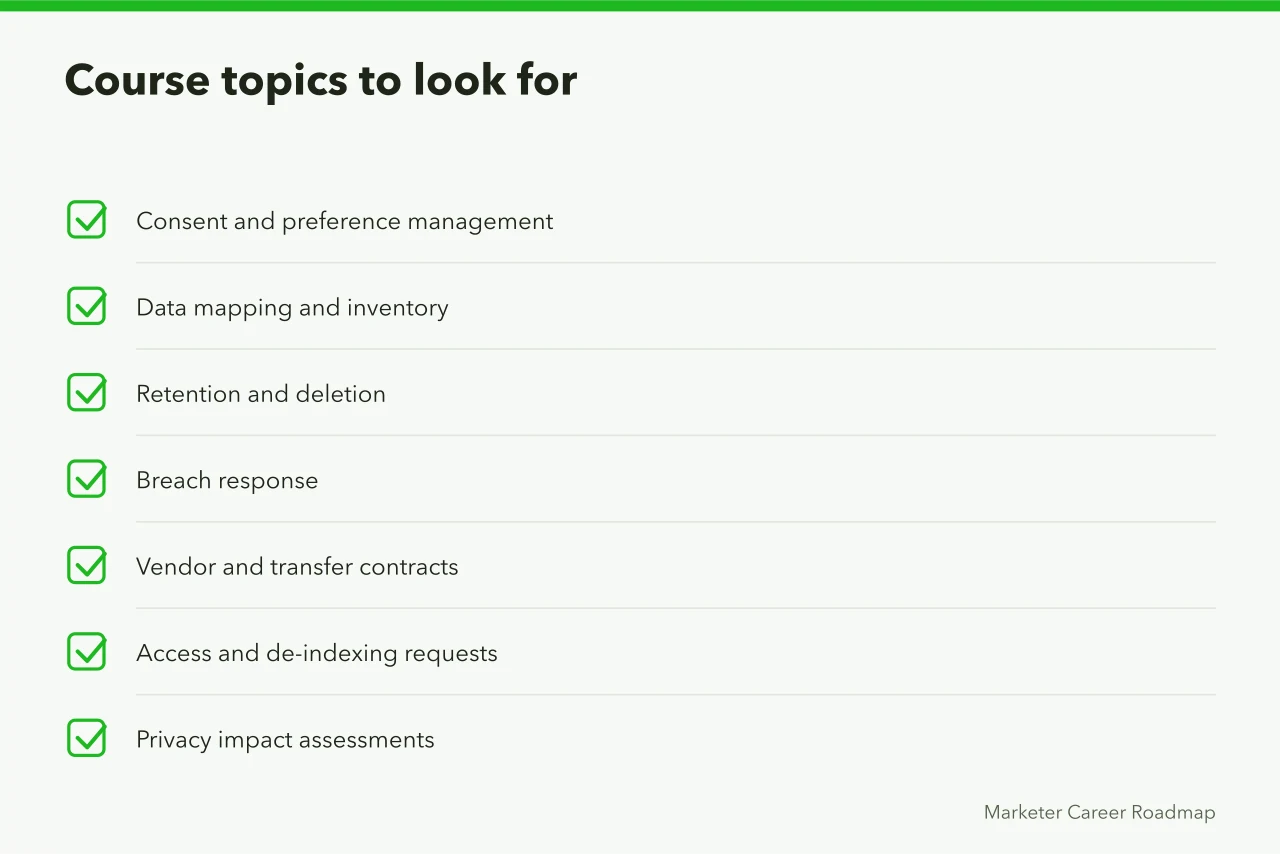
| Course topic | Rule it covers | What you should be able to do |
|---|---|---|
| Consent and preference management | PIPEDA consent principle; Law 25 consent rules | Design a consent flow for web and email analytics |
| Data mapping and inventory | PIPEDA limiting collection | List every data element, its purpose and its source |
| Retention and deletion | PIPEDA limiting use and retention; Law 25 duties | Set and document retention periods by purpose |
| Breach response | PIPEDA breach reporting; Law 25 notification | Run a breach playbook and keep records |
| Vendor and transfer contracts | PIPEDA safeguards; Law 25 transfer rules | Write privacy terms into analytics contracts |
| Access and de-indexing requests | PIPEDA access rights; Law 25 de-indexing | Handle a customer request end to end |
| Privacy impact assessments | Law 25 requirement | Complete a PIA for a new analytics project |
A course that teaches only the first row is a consent course, not a compliance course. Look for at least four rows, and check whether the assessment is a real deliverable such as a data map, a retention schedule or a draft privacy impact assessment.
Where analytics courses usually fall short
Most analytics certificates are tool courses: Google Analytics 4, Looker Studio, SQL, Power BI. Privacy appears as a side note about cookie banners, if it appears at all. That gap is where compliance risk sits, and it is the reason to inspect the privacy module separately from the analytics module.
Another gap is scope. A module written for American state privacy laws will cover opt-outs and sale of personal information, concepts that do not map cleanly onto PIPEDA or Law 25. Canadian buyers should check that the examples are Canadian.
If you publish gated content and capture leads, marketing manager salary negotiation should explain how consent carries from the form to the CRM and into analytics.
Enforcement decisions that shape what courses should teach
The OPC actions and decisions page collects the regulator's findings, and reading a few will change how you judge a curriculum.
Three findings come up often in Canadian course discussions.
Clearview AI, 2021. A joint investigation by the federal, Quebec, British Columbia and Alberta commissioners found that Clearview scraped images of Canadians and built a biometric database without valid consent. The commissioners recommended that it stop offering the service in Canada and delete the images.
Cadillac Fairview, 2020. A joint investigation with the Alberta and British Columbia commissioners examined facial recognition cameras in shopping malls. The commissioners found that the mall operator had not obtained valid consent from shoppers.
Facebook, 2019 and 2023. The federal and British Columbia commissioners concluded that Facebook's consent model failed PIPEDA. In 2023 the Federal Court of Canada agreed that the company breached the law in its handling of user data.
Recurring themes show up. Consent obtained through unclear or bundled language is often found invalid. Retention without a documented purpose draws criticism. Security safeguards that do not match the sensitivity of the data are a common failure. Vendor oversight is another repeat issue.
A program that cannot point to one of these findings and explain what the organization did wrong is teaching theory. The transferable skill is spotting the same pattern in your own stack before a complaint arrives.
The regulator also issues guidance notes that interpret PIPEDA for specific technologies. Those notes translate principles into tool-level advice on tracking, advertising and analytics, and they belong on a course reading list.
What the outcomes actually look like
Penalties matter less than process. Most outcomes involve orders to change practices, along with remediation work and reputational cost. The practical skill is building a process that survives scrutiny: documented purposes, recorded consent, retention schedules and breach logs.
Quebec adds a second layer. The provincial regulator publishes its own findings, and courses that cover only federal cases will miss the Quebec decisions on transfers and de-indexing. Ask the provider which decisions are discussed in class, and in which language.
Reading a finding like an analyst
Take any published finding and answer four questions: what data was involved, what the organization said it was doing, what it actually did, and what changed afterwards. That habit turns a case summary into a checklist you can run against your own analytics setup.
Checking a PIPEDA marketing analytics course before you pay
Start with the syllabus. Search it for the words PIPEDA, Law 25, consent, retention and breach. If those terms are absent, the course is not built for Canadian compliance work, whatever its landing page claims.
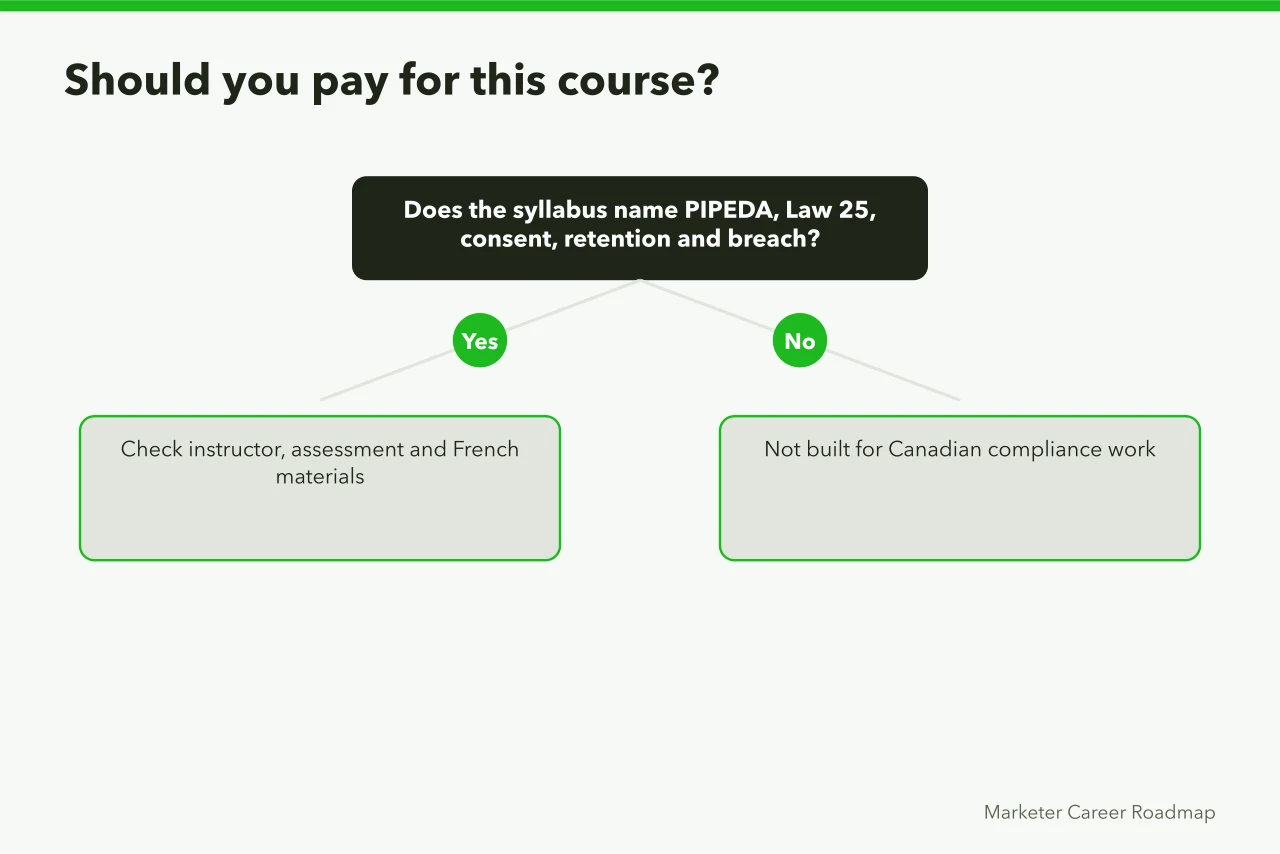
Check the instructor. A privacy lawyer, a former regulator staffer or a practitioner with Canadian client work is a better signal than a general data instructor. Ask whether the instructor has worked with the Office of the Privacy Commissioner of Canada or the Quebec regulator.
Ask for the assessment. A data map, a draft privacy impact assessment or a breach playbook are evidence that you will practise the rules. A multiple-choice quiz at the end is not.
Confirm the language. The federal regulator maintains a French-language privacy topics hub that course providers can draw on. Its existence is a reasonable benchmark for Quebec-ready content. Anyone training for work across Canada and Quebec should see French materials before paying, not after.
Check the price against the hours. If the privacy component is two hours inside a forty-hour course, you are paying for awareness rather than competence.
Typical Canadian privacy modules run two to six hours inside a wider analytics certificate. A dedicated Canadian privacy course usually runs twelve to twenty hours. Expect an added module to cost roughly CAD 200 to CAD 600, and a standalone course CAD 500 to CAD 1,500.
Certification bodies such as the International Association of Privacy Professionals publish CIPP/C prices, which gives you a benchmark against bundled offers. Treat all of these as typical ranges, not quotes.
Finally, ask about updates and tax treatment. PIPEDA guidance and Law 25 obligations evolve, so a course recorded three years ago may already be stale. Quebec residents also claim tuition credits on both a federal and a provincial return, so the net cost of the same course differs between Canada and Quebec.
Confirm what your provider issues before you enrol.
When you compare providers, use a marketing certifications compared approach: list the privacy modules, the hours spent on them, and whether the assessment is marked. A certificate that mentions privacy on a single slide is not evidence of training.